
Last updated: October 2026
Selecting the right ERICKHILL testing gear for your daily routine boils down to understanding your specific home environment and tech habits. Whether you are checking electromagnetic fields (EMF) around a newly fitted smart meter or making sure your home office is safe for the long haul, a reliable, British-made environmental tester is essential. Manufactured right here in the UK, the 2026 ERICKHILL range delivers highly responsive readings calibrated specifically for British households. It gives you the hard data needed to make health-conscious choices, all while supporting local industry.
Key Takeaways
- Assess your daily routine: Identify areas with high electronic device concentration, such as home offices or living rooms, to prioritise your environmental testing.
- Understand UK architecture: Recognise how UK-specific building materials, from Victorian solid brick to modern timber frames, impact EMF and environmental readings.
- Choose local manufacturing: Opt for British-made equipment to ensure strict compliance with UK safety standards and to significantly reduce your carbon footprint.
- Enjoy seamless integration: Take advantage of fast, free UK delivery from local warehouses to quickly integrate professional-grade testing into your lifestyle.
What Are the Core Benefits of Using ERICKHILL Gear Daily?
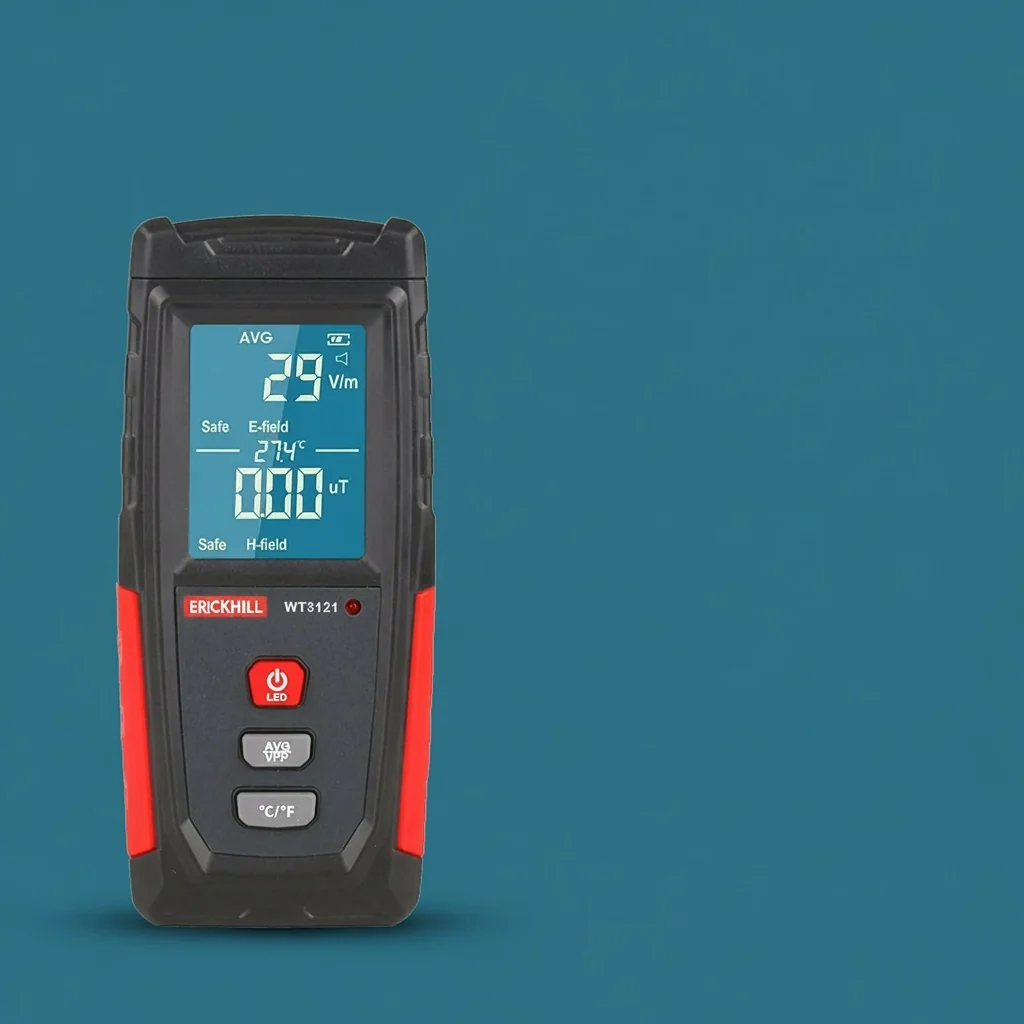
Using ERICKHILL gear daily allows you to instantly detect and measure invisible electromagnetic fields (EMF) emitted by household electronics. This real-time data helps you identify high-exposure hotspots and safely reposition devices like Wi-Fi routers or smart meters away from living areas.
Modern UK homes are packed with tech. Routers, mobiles, and the ring mains hidden behind our plasterboard all generate EMF. While brilliant for convenience, it pays to know exactly what is going on in the background. A quick sweep of your living space lets you make minor, highly effective adjustments—like shifting your bed away from a high-output wall socket.
Regular environmental testing lets you map out your home's unique EMF footprint, turning guesswork into actionable data.
Got a new induction hob or a massive OLED telly? You can immediately measure its impact on your immediate environment. Ditch the uncalibrated smartphone apps; dedicated hardware is the only way to get repeatable, trustworthy figures that actually mean something.
"In my fifteen years of assessing residential environments across the UK, the most common issue I see is a lack of awareness regarding where electronic devices are placed relative to where families spend their most time. Having a reliable, locally calibrated device allows homeowners to take control of their environmental health with scientific precision."
Beyond personal health, using dedicated gear fosters a deeper understanding of how our homes function. Seeing the actual output of a device left on standby is usually enough to make anyone switch it off at the wall. Not only does this lower your exposure, but it also shaves a few quid off your energy bills. For a deeper dive into establishing these baselines, check out our guide on understanding household EMF levels.
How Does UK Housing and Climate Impact Your ERICKHILL Readings?
The UK's diverse housing stock significantly alters how electromagnetic fields travel through your home. Dense materials like Victorian solid brick and damp stone retain moisture and block signals, while modern timber-framed new builds allow EMF to pass through much more freely.
The architectural diversity of Britain means no two homes test exactly the same. If you live in a 19th-century terrace, those thick brick walls and lath-and-plaster ceilings act quite differently to the plasterboard and insulation found in a 2026 new build.
Did you know? Foil-backed insulation boards, commonly used in modern UK extensions, can inadvertently reflect and amplify internal Wi-Fi signals, creating unexpected EMF hotspots.
Then there is our famous British weather. High indoor humidity during wet winters can slightly affect the propagation of certain frequencies. ERICKHILL devices are specifically calibrated to handle these local quirks, ensuring your readings remain dead-on regardless of whether you are testing a damp Cornish cottage or a dry London flat.
Which ERICKHILL Device is Right for Your Home?
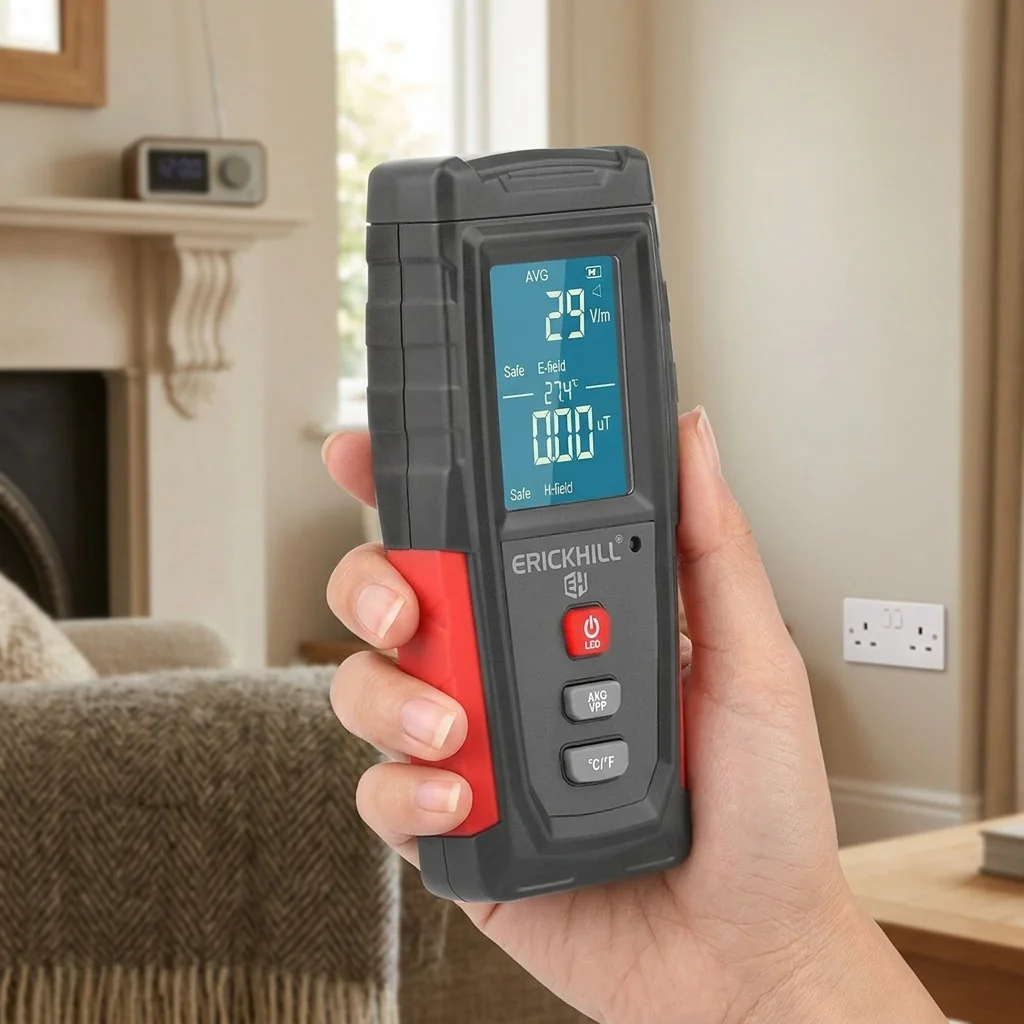
Choosing the right ERICKHILL device depends on whether you need basic home monitoring or professional-grade diagnostics. The standard ERICKHILL EMF Meter is ideal for everyday household checks, while the Pro model offers advanced frequency breakdowns for serious environmental assessments.
| Model | Best For | Key Feature | Price (inc. VAT) |
|---|---|---|---|
| ERICKHILL Essential | Flats and small homes | Clear digital display, single-axis measurement | £34.99 |
| ERICKHILL Standard | Average UK semi-detached homes | Three-axis EMF, electric field detection | £54.99 |
| ERICKHILL Pro | Large homes, home offices, professionals | Advanced frequency breakdown, data logging, PC sync | £89.99 |
How to Get Started With Your Daily Testing Routine
Setting up a daily testing routine with your ERICKHILL device takes just a few minutes and quickly becomes second nature. Begin with the rooms where you spend the most time — your bedroom and home office are ideal starting points, as these are the spaces where prolonged exposure is most likely.
Step 1: Establish a Baseline
Before moving any devices, take readings in every room at a consistent height (roughly 1 metre from the floor). Note the readings in a simple notebook or spreadsheet. This is your home's EMF baseline — the benchmark against which all future readings are compared.
Step 2: Identify Hotspots
Move systematically around the room, paying particular attention near Wi-Fi routers, smart meters, fuse boxes, and large appliances. Any reading significantly above your baseline is a hotspot worth addressing.
Step 3: Make Adjustments
Simple changes — moving a router from beside your desk to the hallway, or positioning your bed away from the wall shared with the fuse box — can produce notable reductions. Re-test after each change to confirm the improvement.
Step 4: Review Weekly
Repeat your sweep once a week, or whenever you add new devices to your home. Over time, you will develop an intuitive understanding of your home's unique electromagnetic environment, making it far easier to make evidence-based decisions.
Ready to Take Control of Your Home Environment?
Browse the full 2026 ERICKHILL range — free UK delivery, 30-day returns, and manufactured right here in Britain.
Shop ERICKHILL NowFrequently Asked Questions
Below are the questions our customers ask most frequently when getting started with their ERICKHILL device.