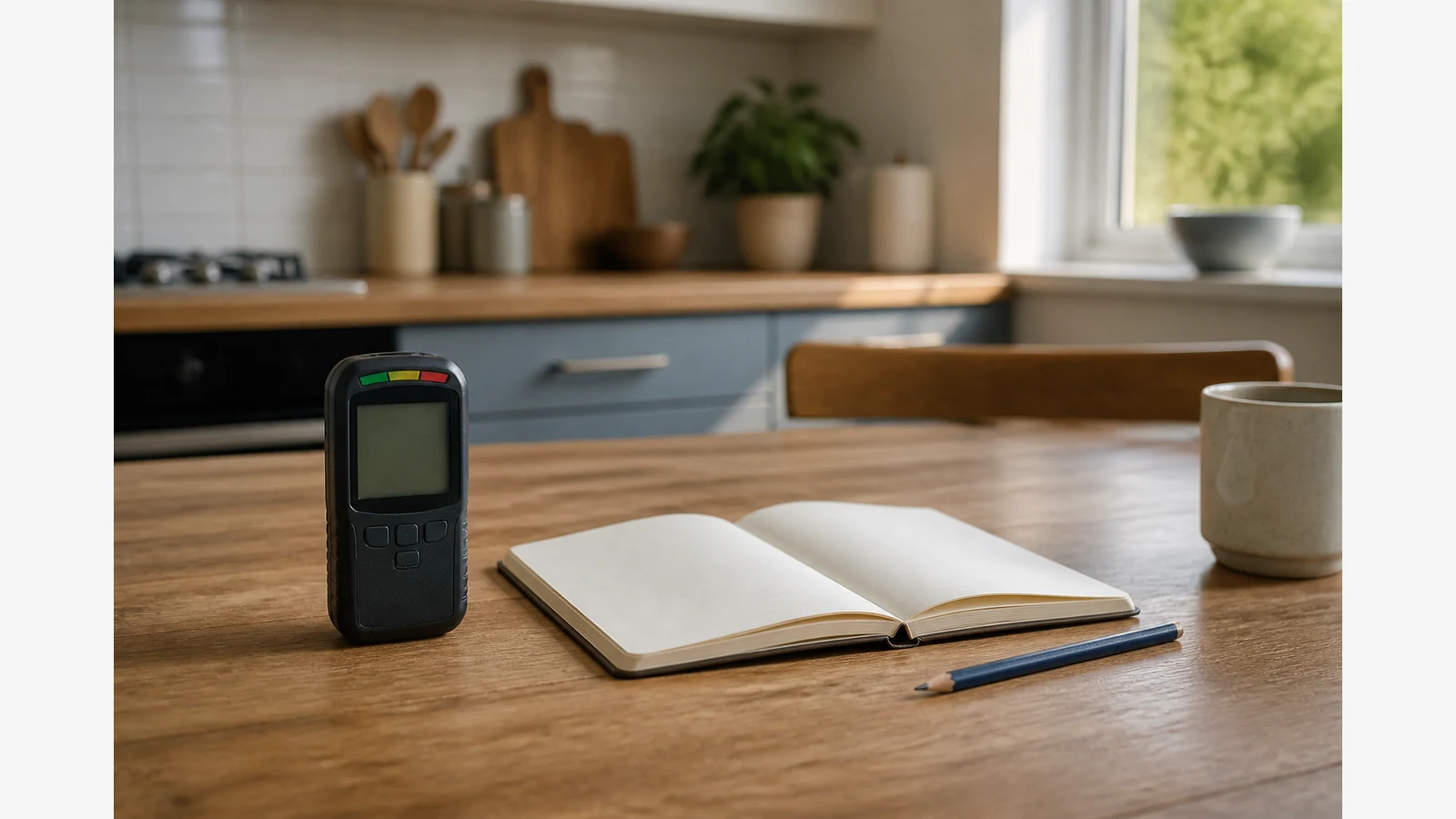
ICNIRP Limits vs Home EMF Meter Readings UK: How to Compare Without Overclaiming
Public ICNIRP and Ofcom limits are compliance benchmarks for transmitters and workplaces—not a DIY medical pass/fail for your kitchen table readings. A handheld home meter is useful for relative room-to-room checks when you log units carefully and compare order of magnitude to published UK guidance, not when you treat a single number as a health verdict.
What UK limits actually govern
Ofcom’s spectrum licensing expects higher-power transmitters to meet the Ofcom electromagnetic fields policy based on ICNIRP general-public guidelines. Ofcom also clarifies that UKHSA leads public-health advice, while its own EMF licence condition follows those guidelines—see the Ofcom EMF FAQs. Separately, the GOV.UK electromagnetic fields overview summarises typical home electric and magnetic field ranges and keeps advice centred on ICNIRP.
A calm decision path for home readings
- Pick one mode at a time (magnetic µT, electric V/m, or RF) and stay in that mode for a whole room walk.
- Note the unit on the display before you write anything down—use confirmed details conversions between V/m, µT and mW/m².
- Log pillow height, desk seat, child’s room, and garden edge at the same time of day.
- Compare rooms to each other first. Only then glance at published public-limit context for order-of-magnitude sense.
- Stop short of claiming “compliant” or “unsafe” for a mast, workplace, or implant case—those need professionals.
What a handheld meter can and cannot certify
| Home source | Useful DIY question | What consumer meters cannot certify |
|---|---|---|
| Router, cordless base, phone on charge | Which spot is relatively higher at pillow or desk? | Ofcom mast compliance or SAR medical risk |
| Consumer unit, underblanket, charger brick | Where do magnetic readings fall off with a step back? | Workplace CEMFAW action levels for employers |
| Street mast / planning notice anxiety | How do rooms facing the street compare indoors? | Formal planning evidence or operator licence proof |
Who should not rely on a consumer meter alone
- Anyone with a pacemaker or other implanted medical device who needs clinical advice.
- Employers and duty-holders under CEMFAW—home curiosity is not a workplace assessment.
- Planning disputes that need calibrated surveys and operator documentation.
Practical next step
If you want a repeatable room log, a tri-mode handheld meter is enough for relative screening. Pair it with the official pages above, and if your worry is a substation sightline rather than units, read our house near electricity substation EMF check. For a product overview after the method, see the ERICKHILL meter detail page.
FAQ
What do V/m and µT mean on a home meter?
V/m is an electric-field unit; µT is a magnetic-field unit. Keep them in separate columns in your notebook—mixing them is the fastest way to create false alarms.
Can my meter prove a 5G mast is “within ICNIRP”?
No. Consumer meters are screening tools. Mast compliance sits with licence conditions and professional measurement, not a single living-room snapshot.